
Warrior Walls
The Al-Akhoum isolation in Amran Governorate has suffered for years from the erosion of agricultural lands due to floods. How did the supporting wall the Youth Leadership Development Foundation constructed help people in the region preserve the scattered agricultural lands on the outskirts of the rugged mountains region?
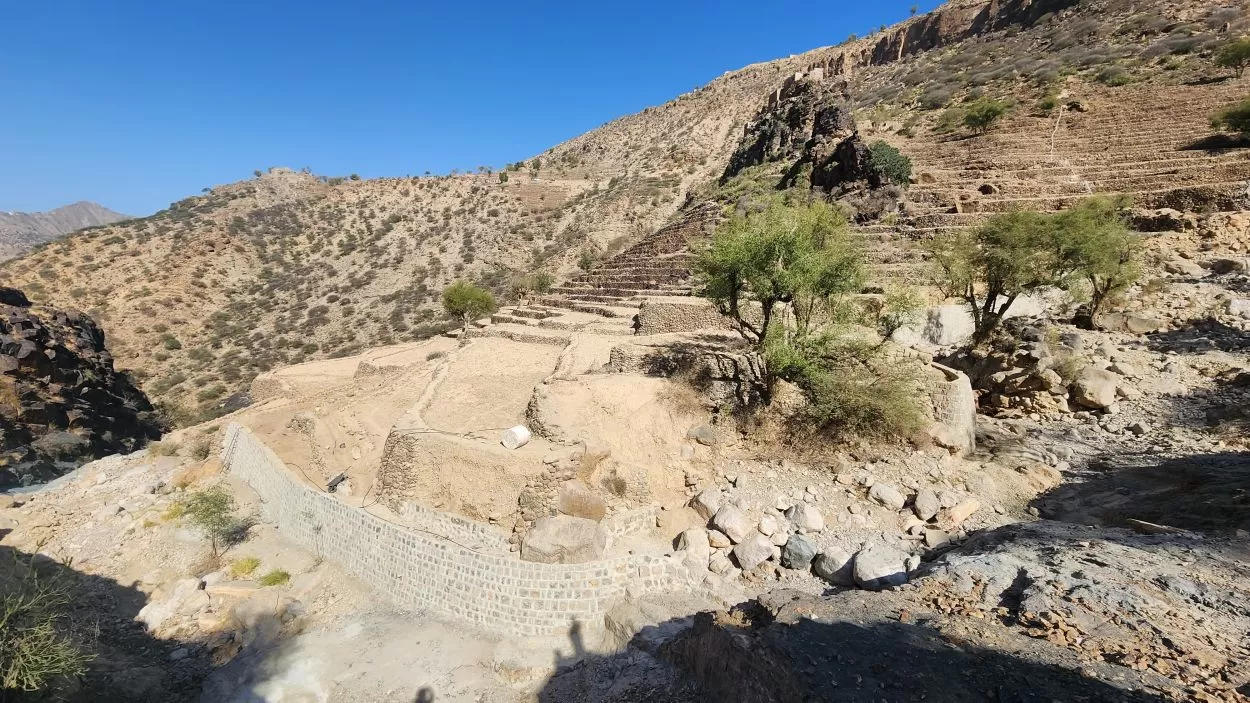
Generous hands and humanitarian partners didn’t reach agricultural lands in the area of Al-Akhoum Mountain in Eyal Yazid Mountain, Amran district, north of Sana’a. As one of the residents said: “The area is isolated and remote, and animals (donkeys) are considered the only means of transportation for people, which makes it a difficult task for local and international organizations to think of building supporting walls for the agricultural lands in a modern way to protect them from erosion.” This explains the fact that transporting rocks from one area to another is considered a risky endeavor due to the danger of slipping from the mountain peaks. He added, ‘This is the first time a local organization has come to help the residents of the area by building supporting walls for the agricultural lands. After the team of engineers from YLDF arrived and conducted a comprehensive survey of the region's urgent needs, they chose to intervene by constructing supporting walls to reduce the erosion of the agricultural lands caused by floods. This is part of the emergency food security and early recovery project implemented by the Youth Leadership Development Foundation in partnership with Diakonie Katastrophenhilfe and supported by Caritas Germany." The project is part of the efforts undertaken by the Youth Leadership Development Foundation and its partners in constructing rock barriers, a successful method for retaining land, which encourages the reclamation of new agricultural lands and the expansion of cultivating new and profitable types of crops. This will enhance the income and food security of the people in the area.
The Beginning of the story:
For the supporting walls construction project, there is a story, that has commenced with identifying its target of improving access to developmental projects and basic services for deprived rural areas. The component cash-for-work (CFA/FFA) within the Emergency Food Security and Early Recovery Project, supports rural communities in preserving and enhancing agricultural infrastructure such as irrigation systems and soil conservation, aiming to mitigate the risks and impact of floods. The overall goal of the project includes Emergency Food Security and Early Recovery implemented by the Youth Leadership Development Foundation in Amran Governorate, enhancing resilience in targeted communities conserving and improving water resources, and also building or rehabilitating traditional irrigation systems. Engineer Abu Talib explains that the project was chosen based on a study of the region's needs, as it is one of the farthest areas in the directorate and very difficult to access.
There are no paved roads to reach the targeted area because it is one of the areas where organizations rarely operate due to the difficulty of access." He says,,.
He added that the selection of the project was based on various criteria, including population density and the number of beneficiaries of the service. The primary needs were the protection of agricultural lands situated on slopes and flood pathways. He pointed out that the residents of the area are actively involved in cultivating wheat and barley, gradually removing Qat trees from the agricultural lands. This encouraged the team to establish the project and meet the needs of the local population in improving agricultural crops and protecting the lands from erosion caused by floods.
Project Execution:
After continuous work by the engineering team and completing the survey of the area’s needs, the project was identified, and implementation began with the assistance of 31 workers from the village of Al-Masnna’a Eyal Yazid Mountain District, whose residents work in agriculture and construction. as part of the cash–for–work program for their efforts in the construction of the supporting wall, which extends along a length of 217 meters. The project's implementation in a remote area represents a ray of hope for families hoping that the project will contribute to improving their economic situation and developing the agricultural environment, nourishing groundwater through the philosophy of "rainwater harvesting," preserving soil moisture, reducing its erosion, providing practical solutions for reclaiming eroded lands, mitigating their natural degradation, reducing surface water runoff, and increasing its storage.
Diligent worker:
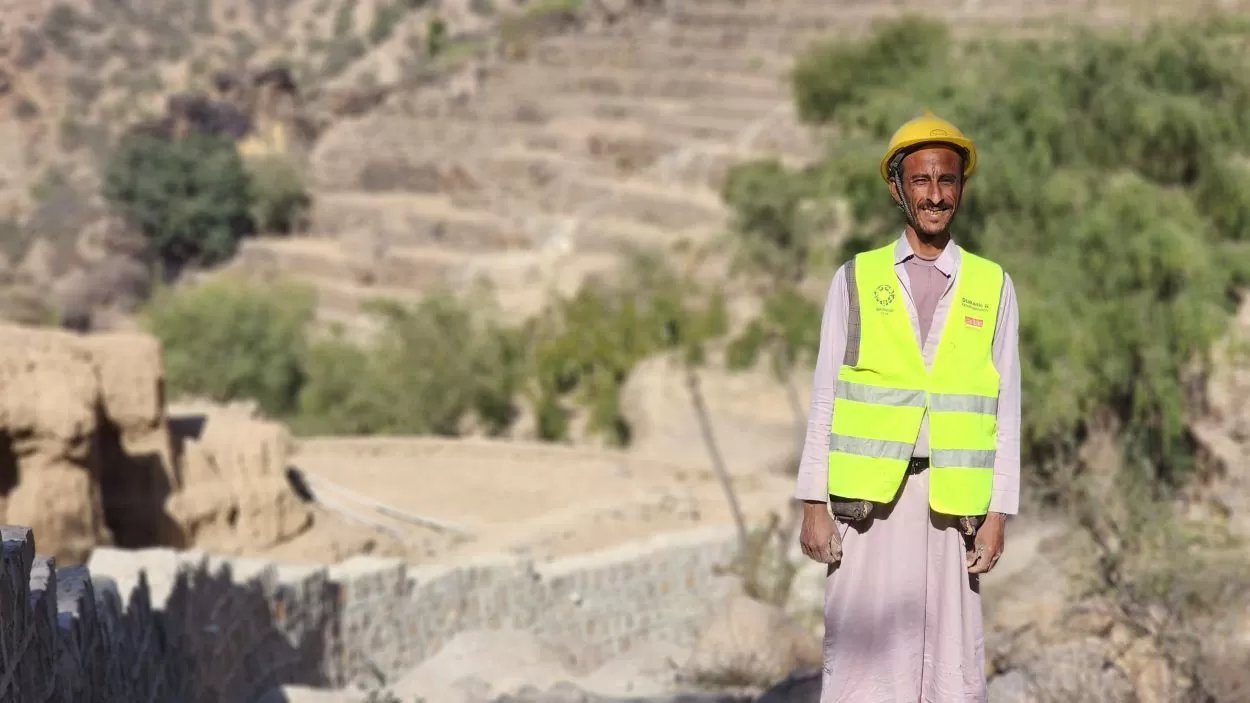
Optimistic worker Mansour Rafiq sits on a rock sticking out of the valley of Al-Masnna’a village, surrounded by towering mountains that push floods toward the agricultural lands. These lands rely on a half-built traditional wall, on the verge of collapse in the upcoming rainy season, expected in June. The thirty-something hard-working laborer, seeking shelter from the burning sun with a helmet and the shade of a tree, speaks about the hardship of transporting rocks on the backs of animals through the rugged rocky paths to be stacked and paved in the retaining wall of the agricultural lands. He showcases the needs of the poor village, drawing attention to the struggle of its students to reach their distant school, forcing them to walk 2 kilometers, hindering the education process. Mansour continues that students are limited to studying until the third and fourth grades from the primary stage until they become proficient in reading and writing. Meanwhile, girls’ education is considered to be an impossible dream due to the rugged village landscape.
He showcases the needs of the poor village, drawing attention to the struggle of its students to reach their distant school, forcing them to walk 2 kilometers, hindering the education process. Mansour continues that students are limited to studying until the third and fourth grades from the primary stage until they become proficient in reading and writing. Meanwhile, girls’ education is considered to be an impossible dream due to the rugged village landscape. He goes back to recounting his suffering in securing food for his family consisting of 10 members, (His parents, wife, and six of his children.)
He adds that the humanitarian interventions of the Youth Leadership Development Foundation and its partners in the neglected, forgotten, and remote villages, facilitate the task of survival amidst complexity. He refers to the Emergency Food Security and Early Recovery project as evidence, which ensured the purchase of essential needs for his family The struggling worker explains that his participation in the Emergency Food Security and Early Recovery project, implemented by the Youth Leadership Development Foundation in partnership with Diakonie Katastrophenhilfe and supported by Caritas Germany, equipped him with the practical skills he lacked as an unskilled worker. This enabled him to learn construction and paving techniques, empowering him to add a room to his hidden house behind a farm, overseeing a supporting wall that protects it from raging floods. He remembers with sadness the suffering of farmers as they resorted to traditional construction to enclose Agricultural lands, gathering and stacking stones and clay at the foothills of the mountains to contain the soil. However, these methods quickly weakened in the face of climate change, with winds and floods sweeping away much of the agricultural land and obstructing pathways in the rugged mountains of the region.
Friendly walls:
he engineering team at the Youth Leadership Development Foundation continued to supervise 211 workers from the local community, representing 20 families who benefited from working on the project as part of the cash-for-work initiative. The team continues the construction and paving work for the supporting wall, which embodies a loyal friend and a strong warrior facing floods to preserve the agricultural environment in the region. As the workers depart, Mansour Yahya Rafiq gazes at the extended supporting wall across the mountains and says with joy, Farmers will finally be able to halt the deterioration and erosion of the soil, providing a suitable agricultural environment to improve livelihoods for the residents of the isolated Al-Akhoum, with a population exceeding 6,982, according to the 2004 Yemeni census. The project, implemented by the Youth Leadership Development Foundation in partnership with support from Caritas Germany and Diakonie Katastrophenhilfe, contributes to finding practical solutions for agricultural lands facing rising temperatures, drought, shifts in planting and harvesting seasons due to changes in rainfall patterns, storms, hurricanes, and raging floods
The Youth Leadership Development Foundation, along with its partners, is implementing a construction and rehabilitation project of the agricultural lands in the targeted areas based on its humanitarian responsibility, finding sustainable solutions to reduce the impact of environmental factors that caused the rise of desertification rate increased from 90% in 2014 to 97% in 2022, which led to an annual loss ranging between 3 and 5% of arable land in Yemen.