

(EFSER) Emergency Food Security and Early Recovery
Project Overview
-
Project Title: Emergency Food Security and Early Recovery Project (EFSER)
-
Project Objective: To improve food security, enhance community resilience, and restore sustainable livelihood opportunities for vulnerable host communities and internally displaced persons (IDPs) across targeted districts in Amran Governorate.
-
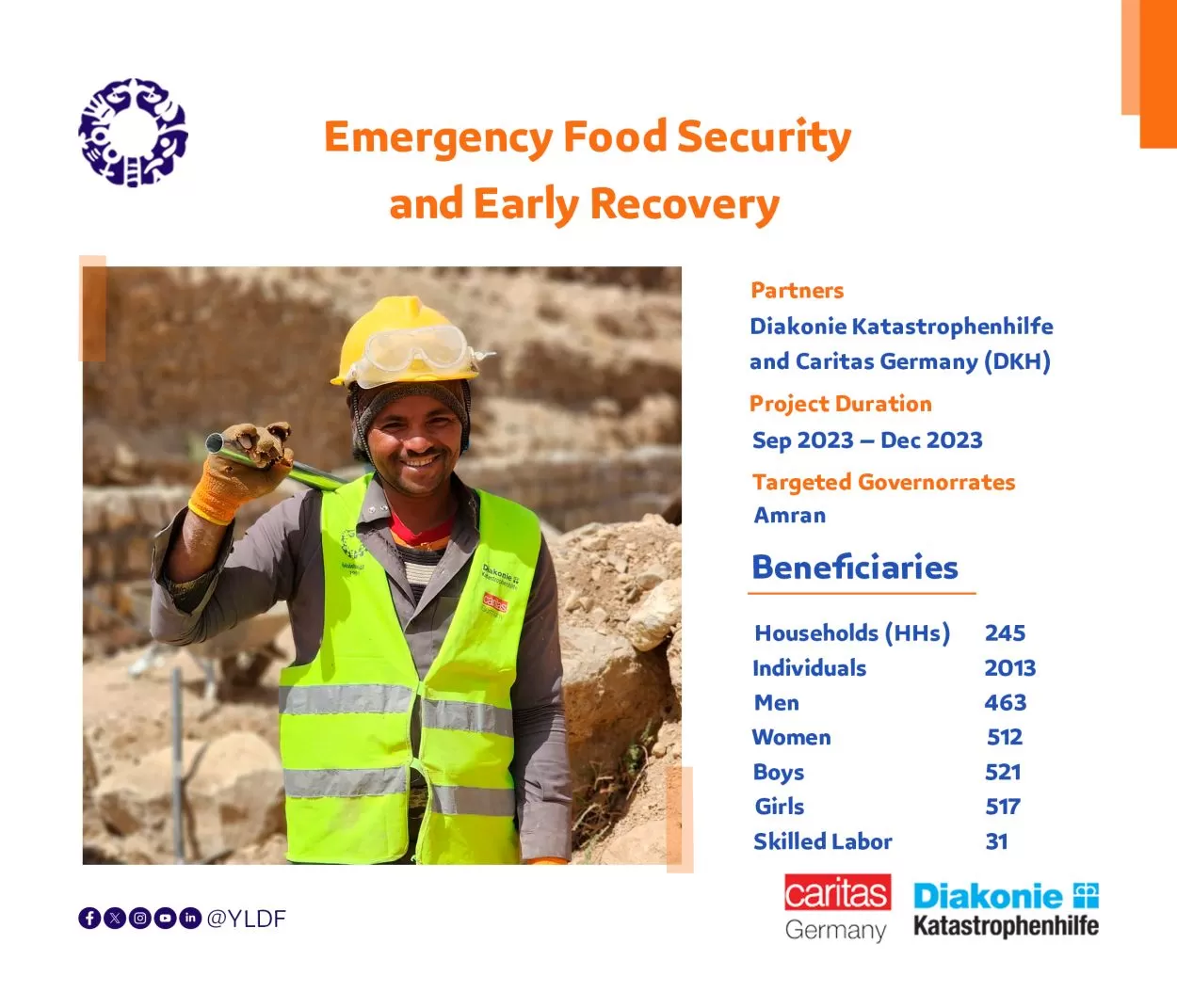
Project Duration: 6 Months (August 2023 - January 2024).
-
Target Group: Socio-economically vulnerable households within host and displaced communities (including men, women, and youth), alongside smallholder farmers and local laborers.
-
Targeted Districts: Jabal Iyal Yazid and Raydah (Amran Governorate).
-
Implementing Partner: Youth Leadership Development Foundation (YLDF).
-
Partner & Funder: Implemented in partnership with Diakonie Katastrophenhilfe (DKH) and funded by Caritas Germany.
Project Details
The Youth Leadership Development Foundation (YLDF) implements a strategic nexus approach that bridges emergency humanitarian assistance with early recovery and long-term resilience. This intervention is designed to mitigate severe food insecurity and create sustainable livelihood pathways in Yemen’s most marginalized rural areas. Addressing critical environmental and climate challenges—marked by a sharp increase in desertification rates from 90% in 2014 to 97% in 2022, which induces an annual loss of 3% to 5% of arable land due to flash floods and severe soil erosion—the project delivers sustainable, asset-protective solutions while securing dignified and continuous income streams for both host and displaced populations.
The core framework of the project focuses on safeguarding agricultural infrastructure, preventing soil degradation from climate-induced floods, and rehabilitating traditional irrigation networks and water harvesting assets. To ensure deep community ownership and strict accountability to affected populations (AAP), the foundation utilizes the Cash-for-Work (CFW) modality as a primary vehicle for socio-economic empowerment. Operations commence with rigorous, evidence-based field assessments conducted by specialized engineering teams to map urgent infrastructure gaps in hard-to-reach areas that typically fall outside conventional aid coverage. Subsequently, local community committees are established to facilitate transparent beneficiary selection, ensuring the equitable inclusion of vulnerable groups while upskilling local laborers into technically proficient workforces.
Spanning from August 2023 to January 2024, and executed through the close partnership with Diakonie Katastrophenhilfe (DKH) and funding from Caritas Germany, the joint field operations successfully delivered climate-resilient water and agricultural infrastructure. Key engineering milestones achieved under the asset rehabilitation component include the completion of two wadi bank protection schemes to arrest soil erosion, the comprehensive rehabilitation of four community water reservoirs to support irrigation, and the construction of two rainwater harvesting structures designed to optimize water management and replenish local aquifers. Furthermore, structural masonry works, including the paving and construction of stone retaining walls and check dams, were finalized to secure mountain terraces against seasonal flood damage.
These multi-layered structural interventions yielded substantial, measurable impacts on local socio-economic indicators. Under the direct intervention and Cash-for-Work components, the project provided immediate financial relief to 245 households, directly benefiting 2,013 individuals (disaggregated into 463 men, 512 women, 521 boys, and 517 girls). This component also integrated 31 artisans who advanced their technical capacities in professional stone masonry and paving. Horizontally, the indirect benefits of the rehabilitated community infrastructure extended to 1,393 households, encompassing 9,651 individuals. In parallel, specialized agricultural extension support was extended to 2,107 smallholder farmers (1,415 males and 692 females) to optimize crop yields and protect their agricultural assets. Complementing these recovery efforts with direct food security support, the intervention expanded its protective envelope to reach an additional 406 food-insecure households, delivering critical assistance to 3,589 individuals, including 793 men, 947 women, 930 boys, and 919 girls.
The profound humanitarian value of this holistic model is prominently reflected in the Al-Askhoum sub-district of Jabal Iyal Yazid. Home to more than 6,982 residents, this isolated mountainous community has historically endured acute geographical exclusion and crumbling access roads—where pack animals remain the primary means of transport—leaving its vital agricultural land exposed to severe degradation and threatening local food supply chains. Amidst these compounding crises, the project catalyzed a life-changing transition for Mansour Yahya Rafeeq, a father of six supporting a multi-generational household of ten. Mansour previously faced constant distress over the imminent loss of his agricultural land and the safety of his children on their perilous daily commute to school. Through his engagement in the project's infrastructure works, Mansour secured the essential income required to meet his family’s immediate nutritional needs, while mastering a professional trade that enabled him to construct a dedicated retaining wall to protect his own home and plot. This structural and economic shift mirrors the broader impact highlighted by Tahany, a fellow beneficiary, who noted that the intervention restored physical, psychological, and food security, effectively shielding vulnerable households from the threat of hunger.
Ultimately, these combined achievements reaffirm that extending targeted interventions to the most remote and structurally neglected geographies does more than stabilize fragile ecosystems—it revitalizes human capital, fosters sustainable recovery, and equips communities to withstand future shocks with dignity and resilience.