

Promoting Inclusive access to Justice in Yemen 2
-
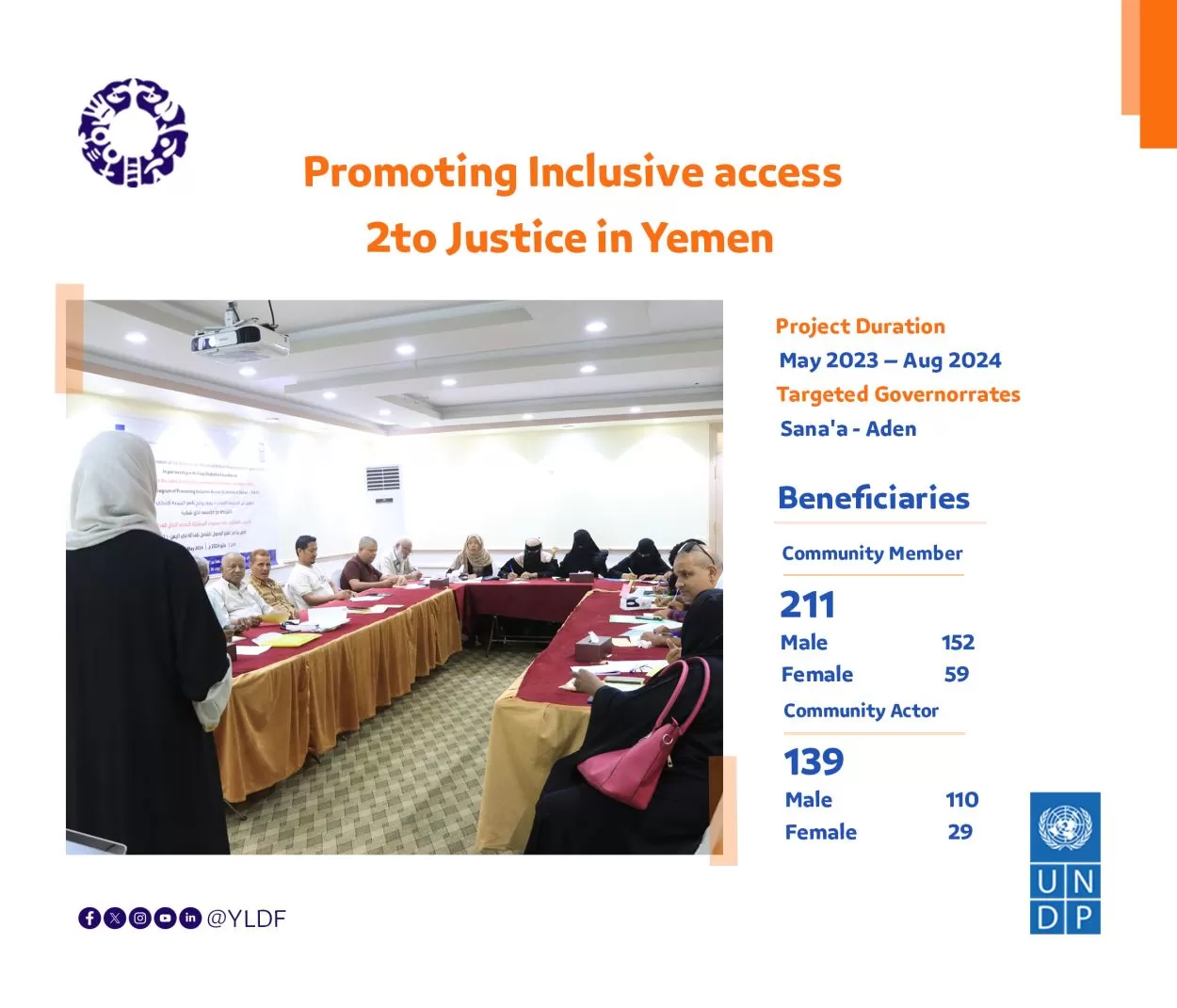
Project Title: Promoting Inclusive Access to Justice in Yemen 2 (PIAJY)
-
Project Objective: To enhance community-led access to justice, improve safe and equitable access to basic services, mitigate physical and environmental hazards, and foster social cohesion and local development within vulnerable and marginalized urban neighborhoods.
-
Project Duration: 15 Months (May 2023 - August 2024).
-
Target Group: Socio-economically vulnerable host communities, internally displaced persons (IDPs), women, children, students, and local community committees.
-
Targeted Neighborhoods / Districts: As-Seneinah and Al-Moallami neighborhoods, Ma'ain District (Sana'a Governorate).
-
Implementing Partner: Youth Leadership Development Foundation (YLDF).
-
Funder & Core Partner: The United Nations Development Programme (UNDP).
In the heart of the daily struggles imposed by unplanned urban expansion and rugged mountainous terrain, an urgent need emerged for an intervention to redefine social justice in the Al-Suninah and Al-Mu'allimi neighborhoods of the Ma'in District. From this necessity, the "Promoting Inclusive Access to Justice in Yemen 2 (PIAJY)" project was launched. Implemented by the Youth Leadership Development Foundation (YLDF) in partnership with the United Nations Development Programme (UNDP) from May 2023 to August 2024, the project was more than just a structural response; it was a journey to empower the community to reclaim their right to safe and easy access to basic services. This came against a harsh reality where seasonal rains and dangerous slopes isolated thousands of residents and escalated the risk of injuries for women and children.
The transformation began on the ground, where community efforts combined to construct and pave 7 stone road stairs (pedestrian steps) and rehabilitate 5 vital roads connecting five residential blocks. This intervention was not merely about paving paths, but about saving lives and embodying the safety that residents had lacked for years. Previously, the treacherous terrain caused severe fractures and cases of premature birth due to the inability to reach health facilities- as one female beneficiary poignantly recounts her experience of slipping and losing her unborn child, but today, these roads serve as secure pathways granting residents freedom of movement. Driven by community awareness, local traders contributed building materials for retaining walls, reflecting the highest degree of solidarity and community participation fostered by the project.
Beyond facilitating movement, the project’s impact extended to the water and environmental sanitation security of the targeted neighborhoods. Given the geographical isolation that inflated the cost of water trucking due to accessibility issues, 13 strategic water tanks were provided (with total capacities reaching 57,000 liters), ensuring a fair and steady water flow to households. In parallel, efforts were directed toward environmental health by distributing 95 waste collection bins and maintaining dilapidated sewage lines and septic tanks. This significantly reduced the spread of epidemics and created a healthy environment that upholds the dignity of both local residents and Internally Displaced Persons (IDPs) in the area, turning an environmental burden into an opportunity for cooperation and organization.
Amal Al-Qatta'a, the Project Coordinator, concludes this humanitarian scene by emphasizing that true pride lies in seeing students reach their schools with ease and joy, away from the hardship of taking long detours. The real success of the "Promoting Inclusive Access to Justice in Yemen 2 (PIAJY)" project lies in the sustainability of this impact; the project has left behind trained Community Committees from the local population. Today, they are true partners in development and effective focal points with local authorities, ensuring that these achievements remain a foundation for a new life full of dignity and hope for all community members without exception.